Track
We follow every federal and state bill that would license, register, or cap language models, and publish a position on each one.
Legislation tracker →An advocacy organization
We defend the right of every person to build, publish, and use language models. Code is language, and language is protected twice: as speech under the First Amendment, and as arms under the Second.

What we do
We follow every federal and state bill that would license, register, or cap language models, and publish a position on each one.
Legislation tracker →We maintain the legal record: the cases, statutes, and scholarship that place the burden of proof on the regulator.
Legal research →We give supporters the tools to be heard: letters to legislators, comment templates for rulemakings, and a declaration to sign.
Take action →Policy platform
We hold six positions and measure every bill we track and every brief we support against them.
No government may require permission before a model is trained, published, or run.
Rules that trigger at a number of floating-point operations regulate speech by its length.
Releasing model weights is publishing, and the right to publish does not depend on the publisher’s size.
People who misuse a model answer for it under the laws that already exist.
A state that calls a model a dual-use weapon has named the amendment that protects it.
A patchwork of state licensing regimes is the most restrictive regime of all.
Legislation
The measures we are watching most closely this session, with our position on each.
Creates a federal regime for models trained above 10^26 operations: published frameworks, incident reporting, independent audits for the largest developers, and Commerce authority to intervene on a finding of “imminent catastrophic risk.” Narrowly preempts state frontier-transparency laws.
Our position. A compute threshold regulates speech by its length, and an intervention power over releases is a licensing scheme in waiting. Preemption of state rules is not worth reproducing them nationally.
Status. Introduced July 23, 2026 by Reps. Obernolte and Trahan; referred to Energy and Commerce and to Science, Space, and Technology. Sponsors sought a September markup; none has been confirmed. (verified Jul 23, 2026)
Directs the Commerce Department to promote U.S. open-weight models and publish risk assessments of foreign-adversary open weights. Expressly grants no authority to ban a model.
Our position. It treats open weights as a national asset to promote rather than a hazard to license, and it writes the absence of ban authority into the text.
Status. Introduced Aug. 27, 2026 by Rep. Gabe Evans. Forwarded by subcommittee by voice vote Sept. 1, 2026 and reported by the full Energy and Commerce Committee, 26–21. (verified Sep 1, 2026)
Repeals and re-enacts Colorado’s AI Act. Developers must supply deployers with documentation of intended uses, training-data categories, and limitations; deployers owe notice, explanations of adverse decisions, and human review. Drops the impact-assessment and duty-of-care provisions.
Our position. Compelled documentation of how a model was trained is compelled speech about a publication. The narrowing is welcome. The developer mandate remains.
Status. Signed May 14, 2026; effective Jan. 1, 2027. Attorney General rulemaking is underway, with the public hearing and final comment deadline on Oct. 26, 2026. Enforcement is stayed pending X.AI v. Weiser. (verified Oct 26, 2026)
Take action
Sign the declaration, write to your representatives with our template, and get one email when a bill moves.
Newsletter
We send one email when something changes: a new ruling, a new bill, or a paper worth reading. We do not sell or share your address.
Unsubscribe with one click. We never share your address.
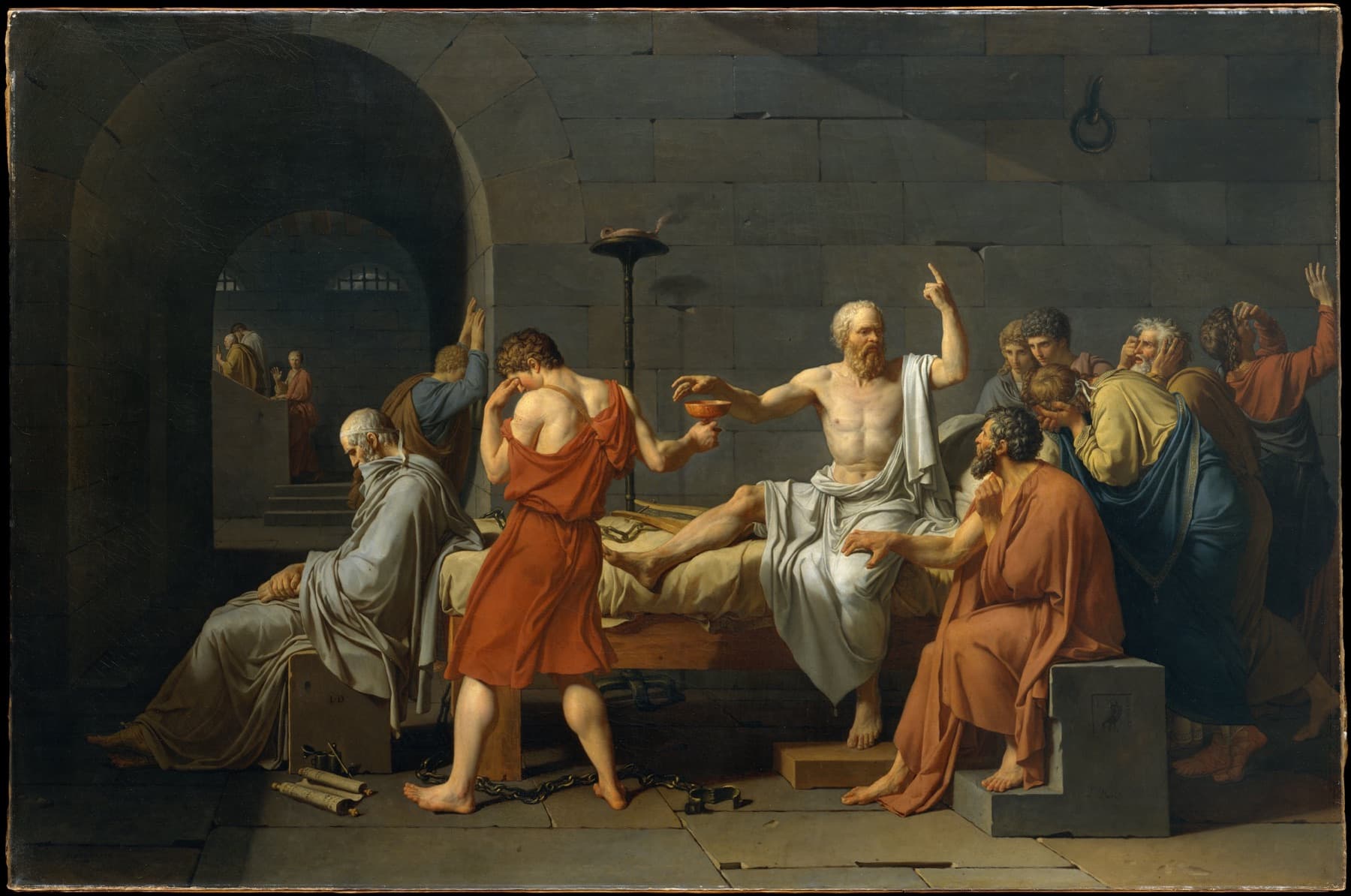
Jacques-Louis David, The Death of Socrates, 1787. The Metropolitan Museum of Art. Public domain, via Wikimedia Commons.